Table of Content
In the “CY 2018 Home Health Prospective Payment System Rate Update and CY 2019 Case-Mix Adjustment Methodology Refinements; Home Health Value-Based Purchasing Model; and Home Health Quality Reporting Requirements” final rule, some commenters shared that there would be increased burden from requiring all-payer data submissions. A few commenters also raised the issue of whether it would be appropriate to collect and report private pay data, given that private payers may have different care pathways, approval, and authorization processes. In the CY 2020 HH PPS proposed rule, we also sought input on whether collection of quality data used in the HH QRP should include all HHA patients, regardless of their payer source . Several commenters supported expanding the HH QRP to include collection of data on all patients regardless of payer. Several commenters noted that this expanded data collection would not be overly burdensome because the majority of HHAs already complete the OASIS on all patients, regardless of payer status. Commenters were concerned that the usefulness of all-payer data collection to CMS's health policy development would not outweigh the additional reporting burden.

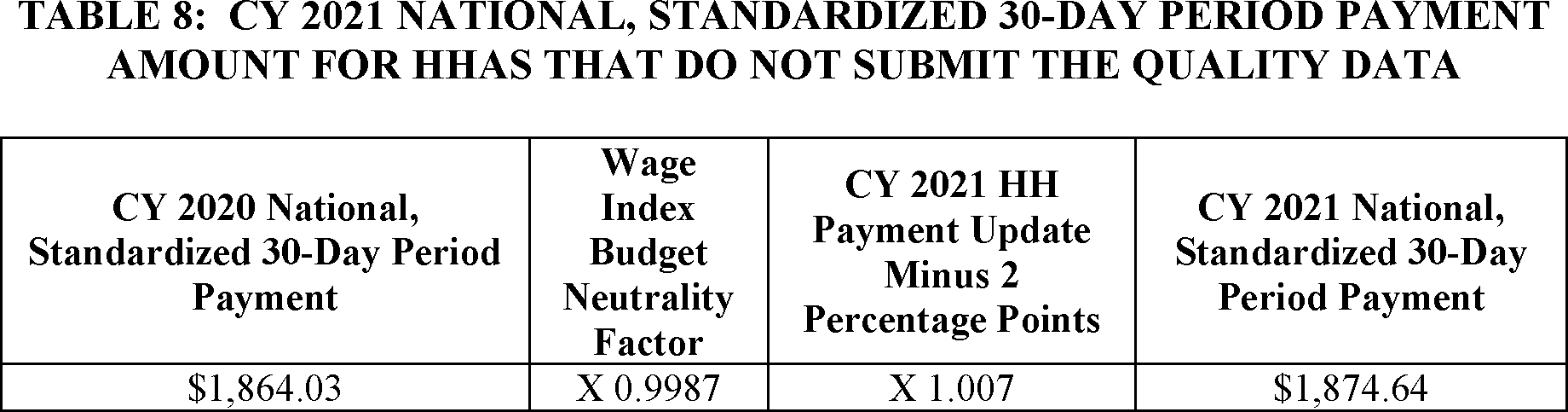
As finalized in the CY 2019 HH PPS final rule with comment period , and as described in the CY 2020 HH PPS final rule with comment period , the unit of home health payment changed from a 60-day episode to a 30-day period effective for those 30-day periods beginning on or after January 1, 2020. These commenters expressed concern that home health providers are not afforded the same options to adjust their wage indices as hospitals, yet must compete for the same types of health care professionals. Additionally, section 1895 of the Act requires that in CY 2015 and in subsequent calendar years, the market basket percentage under the HHA prospective payment system, as described in section 1895 of the Act, be annually adjusted by changes in economy-wide productivity. Therefore, we do not have additional authority to apply an update to the home health payments beyond what is set out in statute.
Estimated Time Spent per Each OASIS-E DAH Assessment/Patient = 2.7 Minutes
We also remind readers the permanent adjustment is based on the percent change between the actual 30-day base payment rate and the repriced 30-day base payment rate for the same year of data . New risk adjustment models with all-payer data would better represent the full spectrum of patients receiving care in HHAs. The submission of all-payer OASIS data would also enable us to meaningfully compare performance on quality measures across PAC settings. For example, the Changes in Skin Integrity Post-Acute Care quality measure is currently reported by different PAC payers on different denominators of payer populations, which greatly inhibits our ability to compare performance on this measure across PAC settings. Standardizing the denominator for cross setting PAC measures to include all skilled-care patients will enable us to make these comparisons, which we believe will realize our goal of establishing consistent measures of quality across PAC settings. Under the HH PPS, LUPAs are paid when a certain visit threshold for a payment group during a 30-day period of care is not met.
Instead, the methodology presented by the consulting firm would be comparing the payment rate and aggregate expenditures based on the previous assumed behavior assumptions to a payment rate and aggregate expenditures based on new assumed behavior assumptions. In other words, any method which controls for therapy provision would result in CMS comparing assumed versus assumed behavior, which would be inconsistent with what the statute requires. Once each simulated 60-day claim is priced under the pre-PDGM HH PPS, we calculate the estimated aggregate expenditures for all simulated 60-day episodes. That is, using actual behavior we determine what the aggregate expenditures would have been under the prior 153 group case-mix system.
Estimated Cost for All HHAs for OASIS-E ROC Assessments =$76,880,473.86 for All HHAs
We refer readers to Table 1.C of the CY 2023 Proposed Reassignment of ICD-10-CM Diagnosis Codes supplemental file for a list of the G-codes related to specified neuropathy or unspecified polyneuropathy. Of the 18 codes, 11 diagnosis codes were not currently assigned a comorbidity group and seven diagnosis codes were assigned to neurological 11 comorbidity subgroup. Additionally, we excluded 14,302 simulated 60-day episodes of care where no OASIS information was available in the CCW VRDC or could not be grouped to a HIPPS due to a missing primary diagnosis or other reason. Our simulated 60-day episodes of care produced a distribution of two 30-day periods of care (70.0 percent) and single 30-day periods of care (30.0 percent) that was similar to what we found when we simulated two 30-day periods of care for implementation of the PDGM. After all exclusions and assumptions were applied, the final dataset included 7,703,261 actual 30-day periods of care and 4,529,498 simulated 60-day episodes of care for CY 2021. This was done to ensure a 30-day period would not have been part of a 60-day episode that would have overlapped into CY 2021.

We solicited public comments on the proposed updates to the LUPA thresholds for CY 2023. The public comments on our proposal to recalibrate the LUPA thresholds for CY 2023 payment purposes and our responses are summarized in this section of the rule. Our clinical advisors reviewed the ICD-10-CM diagnosis code F60.5 (obsessive-compulsive personality disorder) which is currently assigned to the comorbidity subgroup behavioral 6 . However, they noted that behavioral 5 (Phobias, Other Anxiety and Obsessive-Compulsive Disorders) contains other obsessive-compulsive disorders (for example, F42.8 and F42.9) and clinically F60.5 should be reassigned to the comorbidity subgroup behavioral 5. In addition, we evaluated resource consumption related to the comorbidity subgroup behavioral 5, the comorbidity subgroup behavioral 6, and F60.5 and found no significant variations negating a reassignment, meaning the reassignment is still in alignment with the actual costs of providing care. We did not receive comments on this proposal, and therefore are finalizing the reassignment of diagnosis code F60.5 to behavioral 5 when listed as a secondary diagnosis.
Careers
Section 1895 of the Act allows for the provision of an addition or adjustment to the home health payment amount otherwise made in the case of outliers because of unusual variations in the type or amount of medically necessary care. Under the HH PPS and the previous unit of payment (that is, 60-day episodes), outlier payments were made for 60-day episodes whose estimated costs exceed a threshold amount for each HHRG. The episode's estimated cost was established as the sum of the national wage-adjusted per visit payment amounts delivered during the episode. The outlier threshold for each case-mix group or PEP adjustment defined as the 60-day episode payment or PEP adjustment for that group plus a fixed-dollar loss amount. For the purposes of the HH PPS, the FDL amount is calculated by multiplying the home health FDL ratio by a case's wage-adjusted national, standardized 60-day episode payment rate, which yields an FDL dollar amount for the case.
For a given level of outlier payments, there is a trade-off between the values selected for the FDL ratio and the loss-sharing ratio. A high FDL ratio reduces the number of periods that can receive outlier payments, but makes it possible to select a higher loss-sharing ratio, and therefore, increase outlier payments for qualifying outlier periods. Alternatively, a lower FDL ratio means that more periods can qualify for outlier payments, but outlier payments per period must be lower. We invited comments on the proposed updates to the low comorbidity adjustment subgroups and the high comorbidity adjustment interactions for CY 2023.
The dataset they requested, as well as how CMS used that data to calculate the adjustments. Interested parties were thus able to replicate CMS' calculations with the information that CMS made available to them. After applying the exclusions and assumptions described previously, we have the simulated 60-day episode dataset for each year. 51001 of the BBA of 2018 amends section 1895 of the Act by adding a new clause to require the Secretary to eliminate the use of therapy thresholds in the case-mix system for CY 2020 and subsequent years. Document page views are updated periodically throughout the day and are cumulative counts for this document.

This is done because if three or more claims link to the same OASIS it would not be clear which claims should be joined to simulate a 60-day episode. The Department of Health and Human Services has a number of initiatives designed to encourage and support the adoption of interoperable health information technology and to promote nationwide health information exchange to improve health care and patient access to their digital health information. Based on the data, LUPAs appeared most likely to occur in the second period under PDGM.
HHAs attest as to whether equity focused factors were included in the hiring of indirect care or support staff in the applicable reporting year. HHAs attest to whether their strategic plan includes approaches to address health equity in the reporting year. After consideration of the public comments we received, we are finalizing the End of the Suspension of OASIS Data Collection on non-Medicare/non-Medicaid HHA Patients and the Requirement for HHAs to Submit All-Payer OASIS Data for Purposes of the HH QRP, Beginning with the CY 2027 Program Year.

Using more complete CY 2021 claims data , the final FDL ratio for CY 2023 would need to be 0.35 to pay up to, but no more than, 2.5 percent of the total payment as outlier payments in CY 2023. We use 2020 home health cost report data because it is the most complete cost report data available at the time of rulemaking. Other variables in the regression model include the 30-day period's admission source, clinical group, and 30-day period timing. After estimating the regression model using 30-day periods, we divide the coefficients that correspond to the functional status and risk of hospitalization items by 10 and round to the nearest whole number. Those rounded numbers are used to compute a functional score for each 30-day period by summing together the rounded numbers for the functional status and risk of hospitalization items that are applicable to each 30-day period.
More recently in an article in April 2022, it was estimated that nearly half of HHAs had planned to decrease therapy utilization after the implementation of the PDGM. In the CY 2019 HH PPS final rule with comment period , we finalized a policy to maintain the current methodology for payment of high-cost outliers upon implementation of PDGM beginning in CY 2020 and calculated payment for high-cost outliers based upon 30-day period of care. Upon implementation of the PDGM and 30-day unit of payment, we finalized the FDL ratio of 0.56 for 30-day periods of care in CY 2020. Given that CY 2020 was the first year of the PDGM and the change to a 30-day unit of payment, we finalized to maintain the same FDL ratio of 0.56 in CY 2021 as we did not have sufficient CY 2020 data at the time of CY 2021 rulemaking to proposed a change to the FDL ratio for CY 2021.
This suggests HHAs were already beginning to decrease their therapy provision in anticipation of the new payment system. As finalized in the CY 2019 HH PPS final rule with comment period , the PDGM places patients into meaningful payment categories based on patient and other characteristics, such as timing, admission source, clinical grouping using the reported principal diagnosis, functional impairment level, and comorbid conditions. We also finalized a policy in the CY 2019 HH PPS final rule with comment period to recalibrate annually the PDGM case-mix weights using a fixed effects model, as outlined in that rule, with the most recent and complete utilization data available at the time of annual rulemaking. Annual recalibration of the PDGM case-mix weights ensures that the case-mix weights reflect, as accurately as possible, current home health resource use and changes in utilization patterns. To generate the proposed recalibrated CY 2023 case-mix weights, we used CY 2021 home health claims data with linked OASIS data . We believe that recalibrating the case-mix weights using data from CY 2021 would be reflective of PDGM utilization and patient resource use for CY 2023.
Even as the pandemic subsides, agencies are still struggling to adjust to the different thresholds put forth by the payment model. With the ongoing conflict in Ukraine and the still-recovering economy following the pandemic, it is expected that rates will remain unchanged for now. Also, the ECB increased interest rates to fight inflation in July and has already planned another increase in September. One of the benefits of being a homeowner is that you accumulate wealth when owning a home . Model baseline yearmeans the calendar year used to determine the benchmark and achievement threshold for each measure for all competing HHAs. HHA baseline yearmeans the calendar year used to determine the improvement threshold for each measure for each individual competing HHA.


No comments:
Post a Comment